Seven centuries of sound
The history of Gnawa
A music born of displacement and made into a ceremony of healing: from the trans-Saharan trade routes to the stages of the world.
Origins
The Gnawa are descendants of West Africans brought north into Morocco through the trans-Saharan trade between the 11th and 17th centuries, from lands reaching from present-day Senegal to Chad. Linguists trace their heritage to Sahelian peoples including the Soninke, Bambara, Fulani and Hausa.
The name itself is usually read through Berber: agnaw in the singular, ignawen in the plural. In Morocco the displaced communities and their descendants formed brotherhoods that folded their ancestral rites into Islam and Sufi practice.
The lila
The heart of the tradition is the lila, a ceremony that runs from late evening until sunrise. What sounds like one unbroken piece of music is a series of chants, each calling one of the mluk: spiritual entities addressed through seven colours, each with its own incense, rhythm and dance, like a prism splitting a single light.
A clairvoyant, the moqadma, keeps the ritual in order, bringing out the cloths and objects each colour requires, while dancers pass into the trance state called jedba. The maâlem, the master musician, leads it all from behind the guembri, calling the entities to present themselves one by one.
Milestones
11th to 17th century
Enslaved West Africans are displaced north through the trans-Saharan trade, from a broad region stretching from Senegal to Chad. Among them are Hausa, Fulani, Bambara and Soninke people, who carry their music and rituals into Morocco.
Over the centuries
In Morocco those traditions fuse with Islam and Sufi practice into something new: brotherhoods of musicians and healers whose night ceremonies join classical Islamic Sufism with pre-Islamic African ritual.
1998
The Gnaoua World Music Festival is founded in Essaouira. Held over four days each June, its audience grows from twenty thousand to more than two hundred thousand by 2006.
12 December 2019
Gnawa is inscribed on UNESCO's Representative List of the Intangible Cultural Heritage of Humanity, at the committee's 14th session in Bogotá, noting a tradition well preserved and effectively transmitted across generations.
And in Berlin
26 June to 1 August 2026
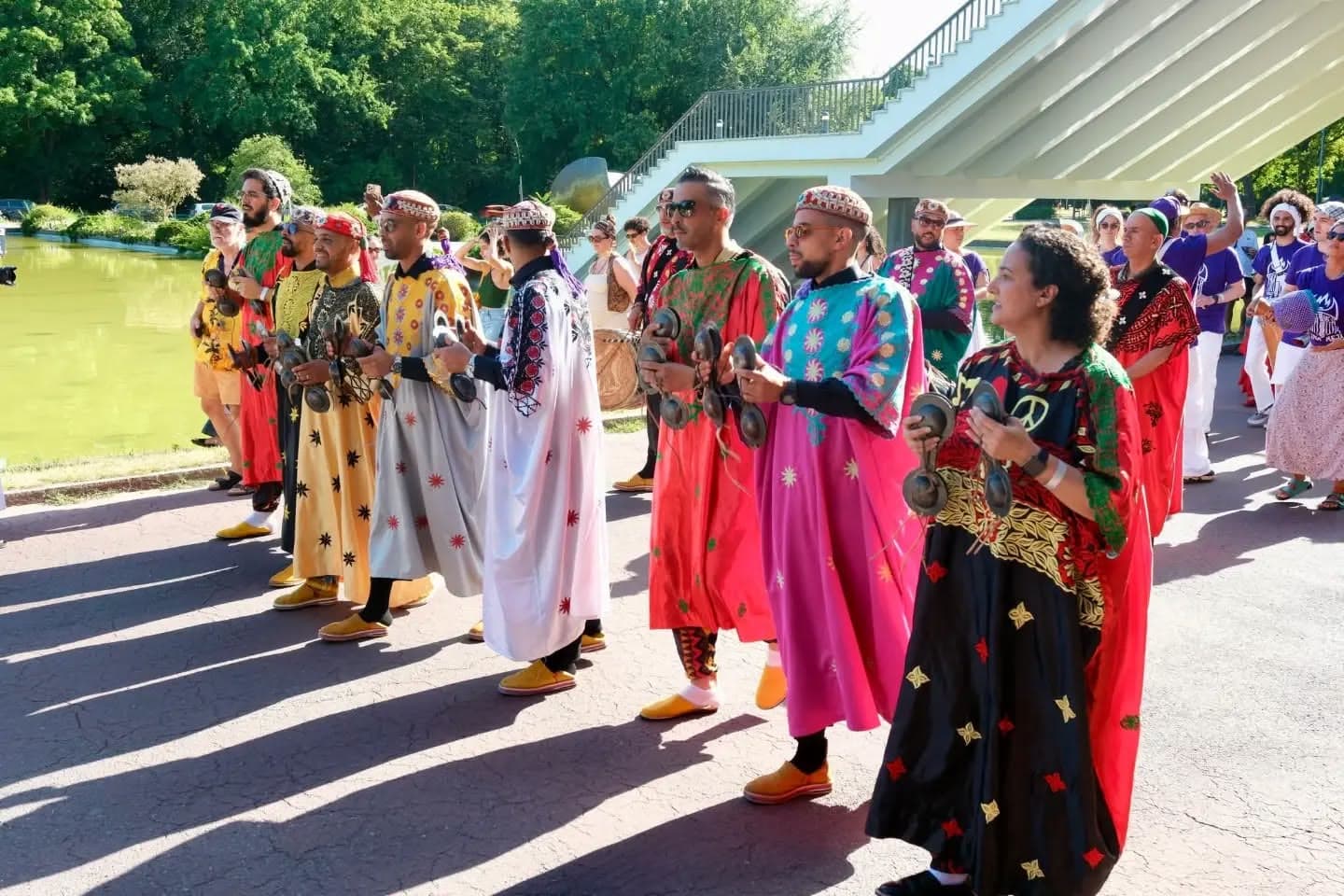
The Sonic Pluriverse Festival at Haus der Kulturen der Welt devotes five weeks to Global Echoes of Gnawa, curated by Alaa Zouiten: concerts, films, panels and workshops tracing Gnawa from its Sahelian roots to flamenco, tarantella and the Afro-diasporic traditions of the Atlantic. It opens with a Gnawa parade from Tiergarten to the House of World Cultures, led by Maâlem Hicham Bilali and Black Koyo, and Gnawa Berlin walks in it.
17 July 2026
A true lila at the Haus der Kulturen der Welt, from 23:00 until 05:00, with Hicham Bilali and Mehdi Nassouli: the night-long ceremony itself, carried into the middle of Berlin.
Gnawa and the world
The guembri, a three-stringed skin-faced lute, is close kin to West African lutes like the Hausa halam, an ancestor of the banjo; the qraqeb, heavy iron castanets, and the tbel drum complete the sound. That sound has pulled the world in for decades: jazz musicians such as Randy Weston and Pharoah Sanders worked with the maâlems; Jimi Hendrix spent time in Essaouira around maâlem Mahmoud Guinia; Brahim Belkane played with Led Zeppelin's Robert Plant and Jimmy Page; Hassan Hakmoun carried the tradition to New York and worked with Peter Gabriel.
Out of those meetings grew the Gnawa fusions: the repertoire folded into jazz, blues, reggae, flamenco and hip-hop, without letting go of the guembri's pulse underneath. That current runs through our own stages too. Maâlem Simou Lagnaoui, who carries the tradition from the UK across Europe, plays with Gnawa Berlin in exactly that spirit, sharing stages and streets with musicians from far beyond the tradition. The photograph below is one such moment: the Global Echoes of Gnawa parade at the Haus der Kulturen der Welt, where we walked and played alongside Hicham Bilali's band and musicians and dancers from Berlin's flamenco and Afro-diasporic communities. The tradition keeps moving, which is how it survived seven centuries. Read more about the band or come and hear it live.
Sources: Wikipedia: Gnawa and Wikipedia: Gnawa music.
The next chapter is played live.
Enter the events